How Team Leaders Track Multiple Open Houses at Once
It's Saturday at noon. You have four open houses running across town, four different agents at the door, and your only source of information is a group chat that's been quiet for 45 minutes. You don't know how many people have walked through. You don't know if anyone captured a pre-approved buyer. You won't find out until the agents text you on their way home.
This is the most common visibility gap in real estate team management, and it costs teams real money every weekend. The good news: it's a solvable problem. If you've ever wondered how team leaders track multiple open houses simultaneously, the answer isn't more phone calls or a dedicated coordinator chasing updates. It's a tighter operating system, role clarity before each event starts, structured communication protocols during, and technology that delivers a live view of every property without picking up the phone. This guide walks you through the full playbook.
Why visibility breaks down when you run multiple open houses
When a team leader manages one open house, informal communication works fine. A quick text, a call after close, and you have the full picture. Scale that to three or four simultaneous events and the informal system collapses. There's no single moment when you know what's happening across all properties at once, and by the time you piece it together from agent check-ins, the window for same-day follow-up has already closed.
The instinct is to call each agent for updates, but this creates its own problems. Agents are in the middle of hosting, which means calls are short, incomplete, and often delayed. You end up with inconsistent data: one agent reports six visitors, another forgets to mention the pre-approved buyer who came through at 1 pm. The information you get is reactive, not real-time.
The most common losses from this breakdown are unrecorded visitors, leads that never make it into the CRM, and hot prospects who don't get a same-day follow-up because the agent didn't flag them. These aren't agent failures. They're system failures, and fixing them starts before anyone unlocks the front door. Teams running three or more concurrent open houses lose visibility primarily because each event gets treated as a separate, manual workflow with no centralized reporting to compare results across locations.
How to staff and schedule multiple open houses without coverage gaps
Top teams schedule open houses in repeating windows rather than one-off slots. A standard framework looks like 11 am to 1 pm, 1 pm to 3 pm, and 3 pm to 5 pm on weekends. This structure makes it easy to assign one primary host per property per slot, spot conflicts before they happen, and hold agents accountable to a predictable commitment rather than a case-by-case negotiation. It also allows one floater agent to cover travel gaps or handoff delays without leaving any property exposed.
No open house should start without an assigned host confirmed in the calendar. For high-traffic properties, a two-person rotation with a 15-minute overlap buffer ensures the door is never unattended during a handoff. The host on the way out doesn't leave until the next host is physically present. This sounds simple, but it's the most common coverage gap teams skip when things get busy.
Each open house needs three clearly defined responsibilities: greeting and capturing visitors at the sign-in point, running qualifying conversations, and logging and tagging leads before leaving the property. On a small team, one agent handles all three. On a high-volume event, splitting them prevents any single function from falling behind. Teams that document these roles in a written brief, rather than assuming agents will figure it out on the fly, run noticeably cleaner events.
Communication protocols that keep every property aligned
A short written brief sent the night before removes most of the questions agents ask during the event. It should cover the property address and parking, the check-in process and tools being used, any known showing restrictions, and the one or two buyer signals the team leader wants flagged immediately: pre-approval status, timeline, and whether the visitor is already represented. This takes five minutes to write and saves a dozen texts on Saturday morning.
Mid-event communication should be structured, not constant. A practical operating rule is one structured update per agent at the halfway point of the open house: total visitors so far, any priority leads flagged, and any coverage issues. This gives the team leader a live pulse without interrupting agents who are mid-conversation. Everything else waits until close unless there's an urgent situation that requires a real-time decision.
Within 30 minutes of each open house closing, every agent should complete a short wrap-up: total visitors, leads logged in the CRM, top prospects flagged for same-day follow-up, and any seller feedback worth sharing. Teams that do this consistently find that follow-up happens faster because the information is fresh and accessible, not reconstructed from memory the next morning. The wrap-up isn't a report for its own sake, it's the handoff that makes the follow-up system work.
How the right technology gives you a live view across every open house
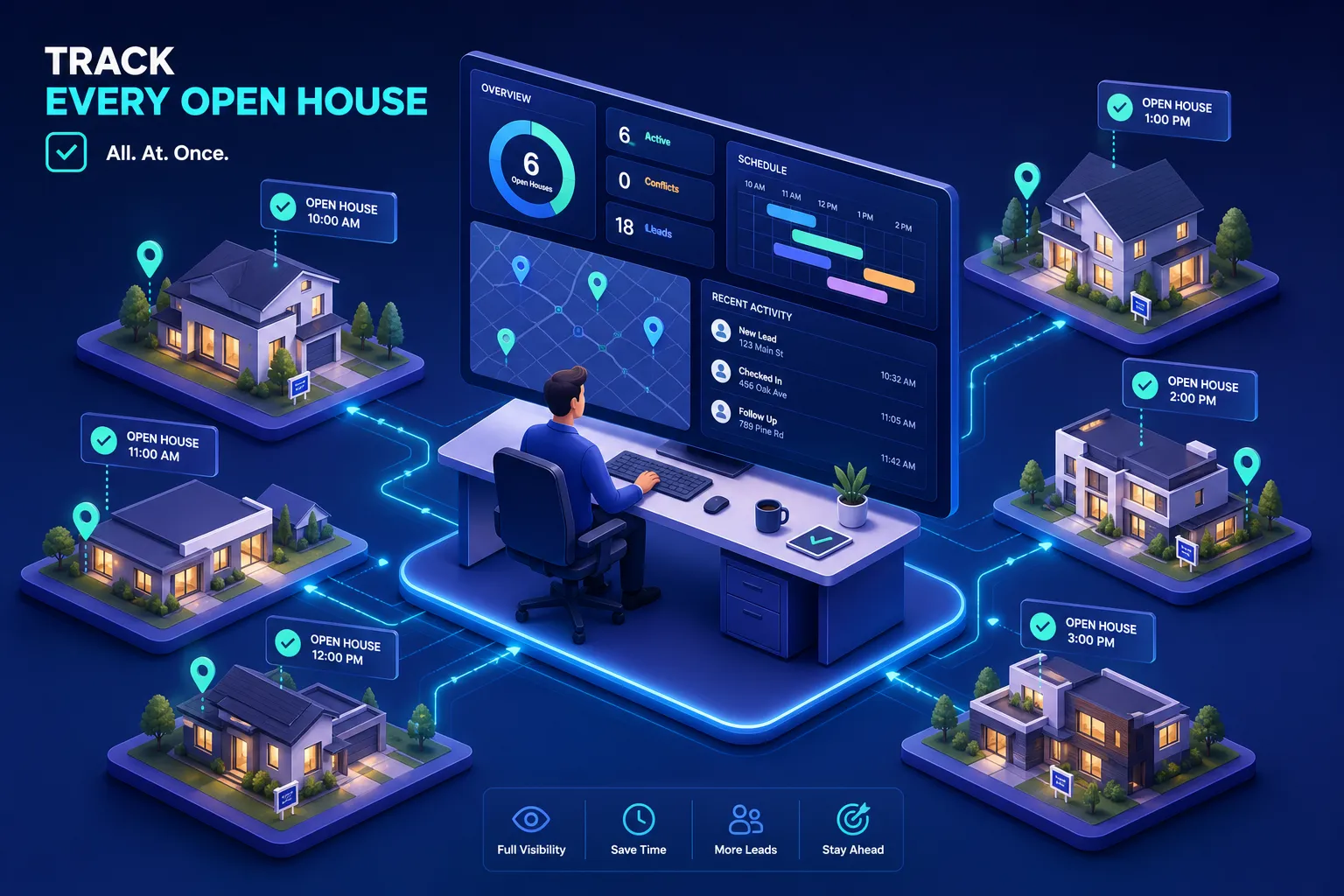
The fundamental shift in open house management is moving from after-the-fact reporting to live data. A team dashboard built for multi-property oversight shows you, in real time, how many visitors have checked in at each property, which leads have been flagged as priority, which agents are actively hosting, and whether any property is running behind on check-ins or coverage. That's the information a team leader needs to make decisions during the event, not after it ends.
This is exactly the problem Foyer was built to solve. Its live team dashboard shows every active open house running simultaneously across the team, with real-time check-in counts, buyer priority scores, and flagged follow-ups for each property. The buyer scoring happens automatically the moment someone checks in via QR code, timeline, financing status, and search fit are weighted and ranked without the agent having to interpret anything.
Team leaders can see which properties have hot prospects and which are running cold, all from one screen, without calling a single agent. For a team tracking multiple open houses simultaneously on a Saturday, this is the difference between guessing and knowing. When a team leader can see a pre-approved buyer check into a property at 1:15 pm, they can prompt the hosting agent to have the right conversation while that buyer is still in the house. That kind of real-time decision-making simply isn't possible when the update arrives in a Sunday morning text recap. Foyer's offline functionality also keeps check-ins running when WiFi drops, so no visitor slips through a connectivity gap at a property with a weak signal.
The follow-up workflow that converts open house leads into clients
The best time to qualify an open house visitor is during the event, while the conversation is still natural. A digital check-in that captures financing status, timeline, and level of interest turns that conversation into structured data. When a tool like Foyer automatically scores and tags leads at the moment of capture, agents leave the property with a ranked list rather than a stack of names that all look identical. That ranking is what makes triage fast instead of guesswork.
Speed is the biggest variable in open house lead conversion. Industry data consistently points to the same pattern: visitors contacted within 24 hours convert at significantly higher rates, and leads reached within the first hour are far more likely to have a meaningful conversation than those contacted the following day. Hot leads, those who are pre-approved with an active timeline and strong interest, need a personal touch within one to three hours of the open house closing. Warm leads should get a follow-up within 24 hours. Nurture leads go into a longer drip campaign. Teams that enforce these SLAs consistently outperform those that follow up whenever the agent gets around to it.
The step where the most leads get lost is the transfer from sign-in data to CRM. Manual entry after a long hosting shift introduces errors, delays, and omissions. Automatic routing that pushes every scored check-in directly into Follow Up Boss, kvCORE, or Lofty, with agent attribution and priority tags already attached, closes that gap entirely. The CRM receives clean, structured data the moment the visitor checks in, not hours later when an agent finally sits down at their laptop. Foyer handles this routing automatically through a webhook you connect once, so the leads that matter most are already waiting in the CRM before the agent even drives home.
KPIs team leaders should track across all open houses
Attendance alone is a vanity metric. The numbers that actually reveal open house performance are:
- Contact capture rate: target 70 to 90 percent of visitors becoming logged leads
- Leads per event: a healthy baseline is 15 to 25 sign-ins with 8 to 12 qualifying as actionable leads
- Follow-up completion within 24 hours: a hard rule, not just a target
- Appointments set per event: 3 to 5 is a strong benchmark at healthy traffic levels
- Lead-to-client conversion: tracked over six and twelve months to reflect the full real estate sales cycle
These five metrics tell you whether your open house program is generating business, not just traffic. If capture rate is low, the check-in system or the greeting process needs attention. If follow-up completion is low, the SLA isn't being enforced or the handoff from event to CRM is broken. If appointments are low despite good capture, the qualifying conversation at the open house isn't identifying serious buyers. Each metric points to a specific part of the workflow, which makes diagnosing problems much faster than trying to act on a general sense that "open houses aren't converting."
Tracking these numbers across multiple events also reveals which agents consistently produce stronger results. Two agents running the same volume of open houses can show very different capture rates, and that gap almost always points to a process difference rather than a personality difference. The data gives you something specific to coach toward instead of something vague to encourage.
Build the system once, then run it every weekend
How do team leaders track multiple open houses simultaneously without burning out or dropping the ball? They stop treating each event as a one-off and start running a repeatable system where visibility, accountability, and follow-up happen automatically, regardless of how many properties are running at once. That means role clarity before the event, structured communication during, and technology that surfaces the right information in real time instead of after the fact.
The teams that consistently convert open house traffic into clients aren't the ones with the biggest budgets or the most agents. They're the ones with the tightest operating system. Every visitor captured, every lead scored, every follow-up sent within the window when it actually matters. Once that system is in place, running four open houses on a Saturday feels no harder than running one.
If you're still piecing together Saturday's results from a Sunday morning group chat, that's exactly the gap Foyer was built to close. The live team dashboard gives you a real-time view of every open house, every check-in, and every priority lead, without leaving your desk. You can try it free for 14 days with full team features and no credit card required, and most teams are up and running in under an hour.